
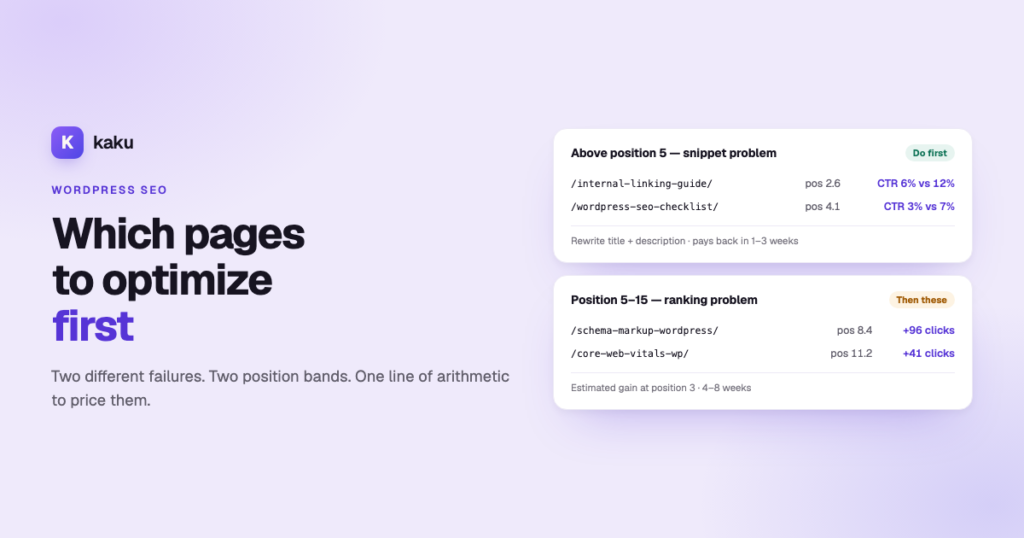

The fastest SEO quick wins are page-one pages with weak click-through; after them come pages stuck between positions 5 and 15. They are two different failures: a page at position 3 with a poor CTR has a snippet problem, and a page at position 11 has a ranking problem. Same question, opposite fix — and mixing them up is why most “quick win” lists do not produce wins.
Nearly every guide answers this with “find your low-hanging fruit” — usually meaning your striking distance keywords — and stops. That is half the answer, and it is the half with the longer payback. The faster money is usually sitting on page one already, in pages that rank well and get clicked badly. If you have been wondering how to improve SEO on WordPress without rewriting the site, this is where to start: you need Search Console and about twenty minutes.
On this page
The short version: two lists, in that order
The whole method, compressed. Use a 28-day window ending three days ago — Search Console lags about three days and including them drags every average down.
- Open Performance → Search results, last 28 days, all four metrics on. Go to the Pages tab and export to a spreadsheet.
- List one — snippet problems. Keep rows with average position better than 5 and at least 200 impressions, whose CTR is at least 30% under what that position normally earns (the table in section three gives you that number). These need a better title and description. Nothing else.
- List two — ranking problems. Keep rows with average position between 5 and 15 and at least 100 impressions. These need the page itself to get better.
- Check for cannibalization before touching either. If two of your own URLs split the same query, that is the problem and optimizing either page separately makes it worse.
- Do list one first, all of it, before starting list two.
Why the order matters more than the lists. Most SEO plans die because the first thing on them takes six weeks to show anything. The snippet list is an afternoon of writing and moves in one to three weeks — which is usually what decides whether there is a second month.
Why this question has two answers
A page can underperform in two unrelated ways, and the average position tells you which one you are looking at.
- It ranks well but nobody clicks. Position 2, 3, 4 — Google already decided you are a good answer, so a low click-through means the title and description are the problem, not the page. The cheapest fix in SEO.
- It does not rank well enough to be seen. Position 8, 11, 14 — indexed and shown, but almost nobody scrolls that far. No title rewrite saves it; the page itself has to get better.
Above position 5, fix the snippet. Below it, fix the page. The average position is the switch.
Treating those as one list is how audits end up recommending a title rewrite for a page at position 14, where it will earn approximately nothing, while a page at position 3 leaks clicks for another six months.
The two bands, with the numbers
| Snippet problem | Ranking problem | |
|---|---|---|
| Average position | Better than 5 | Between 5 and 15 |
| Minimum impressions (28 days) | 200 | 100 |
| Extra condition | CTR at least 30% below what that position normally earns | None — the position is the condition |
| What you change | Title tag and meta description | The content, the internal links pointing at it, the search intent it serves |
| Typical time to show | 1–3 weeks | 4–8 weeks |
The 200-impression floor is higher on purpose: you are about to claim a CTR is anomalous, and a CTR computed from 60 impressions is not a fact, it is a rumour. The 30% gap is the other guard — click-through varies naturally with brand, favicon and SERP features, so a page 10% below par is inside the noise while a third below par is telling you something.
Which leaves the number you need before any of it works: what does a given position normally earn? These are reasonable 2026 figures, already eroded by AI Overviews rather than the pre-2024 numbers still quoted around. Use them as they are.
| Position | Expected CTR | Position | Expected CTR |
|---|---|---|---|
| 1 | 27.0% | 6 | 4.4% |
| 2 | 15.0% | 7 | 3.0% |
| 3 | 10.0% | 8 | 2.1% |
| 4 | 7.2% | 9 | 1.9% |
| 5 | 5.1% | 10 | 1.6% |
So a page at position 3 with a 6% CTR is 40% below par and belongs on the snippet list. At 9% it is within noise — leave it alone.
What each fix is worth, and which to do first
A list of problems is not a plan. What turns it into one — the core of any SEO opportunity analysis — is pricing each row in clicks, which is a single line of arithmetic:
extra clicks = impressions × (expected CTR at the target position − expected CTR at the current position)
For the ranking list, target position 3 — ambitious but reachable from the 5–15 band, and it avoids the fantasy of modelling everything at position 1. A post at position 8.4 with 1,200 impressions earns about 24 clicks; at position 3 it would earn about 120. The prize is roughly 96 extra clicks a month, and now it can be compared against every other candidate instead of argued about. On the snippet list the target is not a better position but the CTR that position already earns: a page at 2.6 pulling 6% where par is 12% on 900 impressions is leaving about 54 clicks on the table.
With every row priced, the order stops being a matter of taste:
| Estimated gain | Position | Priority | Why |
|---|---|---|---|
| 100+ clicks/month | Better than 10 | High | Big prize and close enough that the work plausibly lands. |
| 30–99 clicks/month | Any | Medium | Worth doing in a batch, not worth a special project. |
| Under 30 | Any | Low | Real, but you will spend more on the fix than you get back. |
The high band needs both a large prize and a position better than 10. A page at position 14 with 300 potential clicks is not a quick win; it is a content project wearing a quick win’s clothes.
This is the column to keep. “I rewrote some titles” is not something anyone can evaluate. “These eleven pages are leaving roughly 600 clicks a month on the table, and the top four are an afternoon of work” is a decision someone can sign off. If you have to justify SEO time to somebody who does not do SEO, this line of arithmetic is the whole argument.
What to actually change, per band
Snippet problem — pages already on page one
- Read the actual queries the page ranks for, not the keyword you had in mind when you wrote it. Search Console will tell you; your memory will not.
- Rewrite the title with the phrasing people actually type, under about 60 characters so it survives truncation.
- Write a description that answers the query in the first clause. “Merge, redirect or retarget — with the thresholds” beats “In this comprehensive guide we will explore…”.
- Add what makes a result look worth clicking: a number, a year, a concrete outcome. Vague titles lose to specific ones at the same position.
- Request indexing, then leave it for three weeks. Judging a CTR change on four days of data is how people talk themselves into reverting good edits.
Ranking problem — pages in the 5 to 15 band
- Check the intent match first. If the page is a how-to and everything above it is comparisons, no polishing fixes it — the format is wrong.
- Cover the sub-questions the top results answer and you do not. This is usually where the gap actually is.
- Add internal links to the page from posts you already have. An internal link tool finds the candidates faster than you will, and this is the most underused lever on a page already close.
- Refresh rather than rewrite: the URL has history you do not want to throw away. Then re-measure in six weeks.
Where WordPress quietly costs you clicks
Some of what shows up on these lists is not an editorial problem at all — it is WordPress doing something by default.
| What you will see | What is actually happening | Fix |
|---|---|---|
| A category or tag archive on the snippet list | WordPress indexes archives by default, so they collect impressions on terms your real posts should own. | Noindex tag archives in your SEO plugin. |
| A page with a good position and a truncated title | The theme or SEO plugin is appending the site name, pushing the useful part past the cut-off. | Shorten the title template, or set an explicit SEO title on that page. |
| A high-impression product page with a near-zero CTR | WooCommerce product titles are often the supplier’s SKU string, which nobody clicks. | Rewrite title and description — in bulk if the catalogue is large. |
| A page that moved up and lost clicks | Not a mistake: it started ranking for a broader, worse-matched query. Impressions up, relevance down. | Check the query mix before treating it as a regression. |
Refining it, and doing it at scale
Everything above uses the published CTR table, which is accurate enough to tell an obvious problem from a normal page. It gets unreliable at the margins, because your expected click-through depends on your niche, your brand recognition and the SERP features above you. The more accurate version is to build the curve from your own data: group your query-and-page rows by rounded position and compute the impression-weighted mean CTR of each group — that is what position 3 earns on your site. Only trust your own number where you have at least 1,000 impressions at that position, and interpolate between positions rather than rounding down.
On a site with fifty URLs a spreadsheet is the right tool for all of this. It stops being the right tool at the point where building that curve by hand takes longer than the fixes it recommends.
That is what Kaku’s SEO opportunity finder and CTR optimizer do, inside its Search Console Insights: they read the last 28 days from your own Search Console, build the expected-CTR curve from your site’s rows — falling back to industry figures only for positions under 1,000 impressions — and return the two lists separately, with the estimated gain of each already worked out. These two tools are on Pro and above, not in Free or Starter, and they need Search Console connected.
Not ready to pay for that? Cannibalization detection is on every plan including the free one, consumes no credits, and is the check this article tells you to run before optimizing anything.
See both lists for your own site
Connect your WordPress and your Search Console, and Kaku sorts your pages into snippet problems and ranking problems with the prize for each one estimated in clicks.
SEO quick wins, answered
Pages that are already close to earning more clicks, so a small change pays back fast: a page-one result with a weak title and description, or a page stuck between positions 5 and 15. It is the same idea as SEO quick wins, and the two lists in this article are how to find them in your own Search Console.
Queries where a page already ranks between roughly positions 5 and 15 — close enough that improving the page can plausibly push it onto page one, but far enough down that it earns almost no clicks today. They are the standard starting point for a quick-win audit.
Low CTR, in almost every case. A title and description rewrite takes an hour, needs no new content and typically shows movement within one to three weeks. Ranking work takes weeks of effort and months to show. Do the fast one first so the programme has something to show for itself.
Use 200 impressions in 28 days before judging a page’s click-through, and 100 before treating a position as a real opportunity. The CTR threshold is higher because a click-through rate computed from a handful of impressions swings wildly on one or two clicks.
Around 10% as a starting benchmark in 2026, against roughly 27% at position 1 and 5% at position 5 — lower than the figures quoted before AI Overviews. Treat a page as underperforming when it sits at least 30% below that, and only when the query has 200 or more impressions in 28 days.
Roughly, yes. Expected click-through at position 3 is around 10% against about 2% at position 8 — a five-fold difference on the same impressions. That gap is why the 5-to-15 band is worth systematic attention rather than occasional tinkering.
Stop and treat that first. Optimizing either page in isolation while they split the same query wastes the work, and consolidating them sometimes removes the problem you were about to spend a week fixing.